This short memoir piece was one of the ten winners of the Fish Short Memoir Prize 2018. It was published in the Fish Anthology 2018, available at Fish Publishing.

The Logic of Blue Pyjamas – Reading into my life
(audio version, with me reading this, is here )
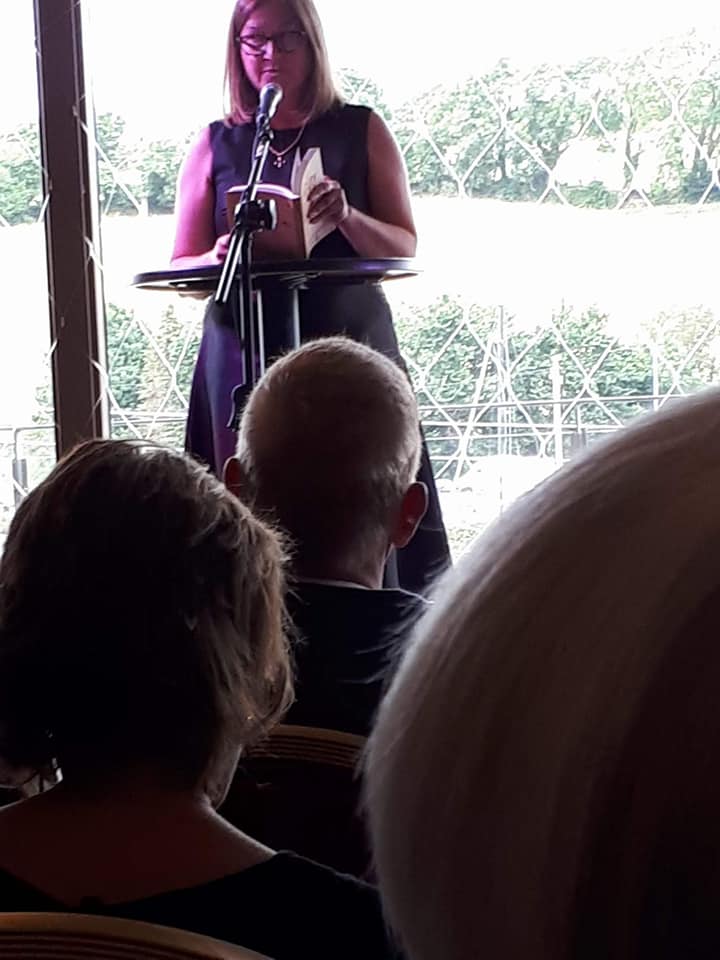
August 2017
Historic abuse, I think. Write it all down. Present tense. A good description for how I’m writing my memoir. Living it now. Trying to stay present. Pretty fucking tense. But memory is a problem for the present. Feels easier to navigate when it’s all been and gone, back then, behind you. So is this writing strategy making it worse? Here comes another wave, overwhelming. No chance for time to think, to breathe, just struggle to hold it together, to stay at the computer, typing, thoughts disappearing into quicksand in my muddled, muddied head. I want clarity, drown in doubt. At my core, I know it is clear – something I need to find out, be sure of – but somehow I’m lost trying to get there. A little girl desperately trying to articulate something but she can’t find the words. I’m most tense when she’s present. Panicking under a calm surface, failing to be understood. She cries at stories of rescue and I assure her she’s safe with me. Me and Fuckit. We’ll never give up. I’m a pacifist, but she’ll fight to the death for us. I would for my daughters and their daughters. Mother daughter connections always make me cry. Sudden instant sobs, as does putting my face in the towel after a bath or shower. Predictable triggers that still catch me unawares.
Time for a break. Pick up a book. Books have saved my life. Our lives. Me and her and Fuckit. Feminism has saved us. And we’re OK, honest. Admittedly, I stagger sometimes, weighed down, overloaded, with my heavy rucksack, laptop, ipad, notebooks, books, newspapers, diaries, too much information that I hold onto, search through, struggling to pin down that elusive something, conclusive research, anything that might convince me, me more than anyone. I read everything, including ‘the other side’, the seemingly credible – at face value, first reading, at least – people who tell me I am bad or mad, cruelly mistaken, not OK, a liar. Fuckit fights panic, resists going under, swears a lot. That helps. Calling the bastards fucking bastards. I cheer and sneer, rarely to their faces, though Fuckit would. Silence doesn’t help, but there’s lots, from all sorts of people. Silence scares me. Theirs. Mine. I try to write what I can’t say. But the other day I spoke my frightening truth out loud – as if it were beyond doubt. To a friend, quizzing me on something else, then slipping in the question, me completely off guard. Normally, I qualify, say, I’m not totally sure my father did this. Perhaps there’s another explanation. Telling her emphatically like that, left me – amazingly – feeling stronger, because, to my surprise, I wasn’t frantically worrying I had misled her, misrepresented me, betrayed him. There’s a niggle about that, a forever what-if-I-am-bad that I am learning to live with, but not a gaping hole opening up. Not a hole I need to jump into and dig and show her my digging. Breathe, Fiona. You have told Diane and you are alright. I didn’t even say that it’s complicated. I breathe. This will not kill me, nor my father. I slump down on the floor, motionless, book at my side, breathing, still.
Part of me is stunned, struggling to gather thoughts, reach out, seek help but stay strong and survive the hurt if nobody comes. Fuckit says ‘fuck them’, pulls me up, places me back on the couch and goes outside for a smoke. I can’t stand smoking, but I let her off. How could I not? I kind of kidnapped her. Stole her from a magical memoir of myriad inner voices, wanting a Fuckit of my own. A walking talking angry inner teenage rebel ready to fight off all comers. She came to help. But only agreed if she could still smoke. I needed her, need her, present tense.
She returns, looks at me piling books and articles by the computer and shakes her head.
What’s up? I ask.
S..l..o..w d…o…w….n, she says.
I sit down hard, concede my heart is racing. A familiar, urgent sleepiness takes over, then suddenly my head is shaking no. Inside I’m saying no, no, no, no, no – the imagined, then actual pitch getting higher. My thighs are on that compulsive in and out movement I find so upsetting. Trying to stop the ‘no’s, force my head still, make my legs clamp shut, finally I am a little calmer. No choking, retching sensation this time. But I’m in no state to stand, get back to my ancient iMac. Will I ever finish the book.
You will, you really will, says Sure Voice, also ‘borrowed’.
The book and the books, I think, remembering my MLitt essay, companion piece to my memoir. It looked at nine books that were key in helping me navigate to my core, in helping me believe that I am OK.
I am OK.
Show your working. The memoir does that. The body led the way. That is the fact of the body of my memoir, of me. Now. Present.
Breathe, Fiona.
Fuckit blows smoke rings and laughs. Sometimes, she’s not my favourite person. My nose wrinkles in disgust. Not the smoke. The yucky anal feeling is here. She notices my distress, stamps out the cigarette – on my lovely carpet – and embraces me in the tenderest of hugs.
It’s what my body needs. To be held safely, no red flags setting off alarm bells in a PTSD type reaction. I breathe and feel some strength returning.
September 2017
I’m on a journey with my sister Anna. Auntie Sheila’s memorial service. I lean forward from the back seat of her new husband’s campervan to chat with them as he drives us south. He joins in some of the wide-ranging topics, her recent job application, their wedding photographer’s wonderful close-ups of all the children, then he listens as we speak about the ongoing impact of long-ago childhood sexual abuse on our wider family. My 1995 accusation against our father, his denial, and all that has happened since. He’s too disabled to attend tomorrow, following a bad fall last year, on top of cancer and a stroke in the last ten years. I’ve not seen him since late 2013, and only a small number of times since my bombshell. I kept my daughters away after that. My granddaughters have never met him.
The meal for nineteen close family members goes well, although later I’m all churned up. At breakfast I tell my siblings that I didn’t sleep much, woke early to write. They know about the memoir.
Thankfully the formalities – at the university where Sheila was a professor of education – are more celebration than mourning. My cousins, their children, my mother, her other sister Margaret and the rest of us all smile and laugh through the speeches. Treasured family memories are recounted. Educationalists from around the country applaud Sheila’s political nous and maverick persuasiveness. One speaker describes how she would disarm government ministers and university boffins with her catchphrase of ‘I’m a grandmother from up north’, before nailing them on the need for evidence to justify their claims and plans.
Margaret writes in the condolence book and tells us it’s about an incident in the nursing home, when Sheila’s Parkinson’s was really bad. Realising what she must be referring to, I’m thrown back to 1996, and Sheila immediately dismissing my ‘recovered memory’ account, suggesting ‘false memory’ and proposing that, even if I were right, I should leave it in the past, get on with my life.
I tune back in to Margaret’s affectionate tale. Sheila’s mind was going, but implicit memory from her professional life kicked in one day when she was encouraged to eat more soup. Cajoled with ‘it’s good for you’, she asked sharply, ‘where’s your information?’ The group we are talking to laugh in recognition. I say to Margaret that Mum did tell me, but relayed the question as ‘where’s your evidence?’
The conversations continue but I am thinking maybe I misremembered it as the more legal-sounding evidence because of Sheila’s scepticism. She had quoted American False Memory Syndrome Foundation material to my parents, not deigning to ask me more than they told her. Yet she knew my accusation had prompted a revelation of other admitted abuse in our wider family, not by him. Not proof of my claim, but it showed abuse had happened in this apparently OK family. I asked Sheila to be sceptical of the sceptics who challenge so many abuse cases regardless of whether memory is relevant.
It took me several years to feel sure enough that I wasn’t mad or naively conjuring up false memories. I was caught in a Schrödinger’s limbo of a good and bad father co-existing, when surely only one could be alive, real?
My complex experience of coming to believe my father was guilty – bad – despite no visual memories of specific incidents, happened while I was a journalist, frequently assigned to report on child sexual abuse – including interviewing survivors and often covering developments in the news, such as the Orkney controversy and others. I already had a strong feminist understanding of the regular vitriolic backlash to revelations of the extent of sexual abuse, from excellent work such as the writer and journalist Beatrix Campbell’s book Unofficial Secrets, about the 1987 Cleveland case. However, the idea that my gentle, kind, pacifist father could have sexually abused me felt as incredible as alien abduction. Or rather, my head told me that. My body told me differently.
‘I was always careful not to touch the children the wrong way in the bath,’ he said to the others, hours after I accused him. My mother didn’t remember him saying anything about that when we were little. And of course, that was years before people started speaking out, tentatively, then more openly, about childhood sexual abuse. Conceivably, her memory could be affected by having been frequently severely depressed back then. She stands by him. Does not believe me. If she comes to believe I’m right, she said a couple of years back, she wouldn’t leave him. He needs her, being so disabled.
Fuckit blows raspberries when Mum’s not looking, and marches about with placards saying Lying Perpetrator Syndrome and False Innocence Belief Syndrome.
Heading home late afternoon, I tell Anna and Phil about a new American true-crime book whose title I love. It combines memoir with an investigation into the background of a death row convicted murderer called Ricky Langley. He strangled six-year-old Jeremy Guillory in Louisiana in 1992. I heard the author Alexandria Marzano-Lesnevich speak about it at the Edinburgh Book Festival, interviewed by crime writer Val McDermid.
‘It’s so well done, the way she weaves together researching the murder with her story of sexual abuse by her grandfather,’ I say. ‘The case haunted her for years. She was an intern for a well-known British lawyer, Clive Stafford Smith. He campaigned in America against the death penalty. She was strongly opposed. On day one there, she was shown a video of Langley confessing to sexually abusing children. He’d just been sentenced to life imprisonment after a retrial. But as she watched, she wanted him dead.’
‘Powerful,’ says Phil.
Anna is twisted round in her seat, looking back at me, as he drives us on into the night.
‘She says it was the memories that her body held which came up as she watched the video. Weirdly, she couldn’t hold onto Langley’s name over the next few years. She would read a newspaper cutting, then seconds later his name was gone. Vanished from her mind. Her sister was abused too, but their family never spoke about it after Alexandria told her parents. They stopped the grandfather babysitting but did nothing else.’
‘Can I borrow it?’ Anna asks. ‘What’s it called?’
‘The Fact of a Body. I like the way she tries to show and understand the murderer’s life history, from when he was in the womb. As a teenager, he asked for help about his sexual attraction to children. She also talks about class differences. His family were poor. Her parents were lawyers. Her grandfather was never reported to the police, let alone prosecuted.’
‘Like so many sexual abuse cases.’
I nod at Anna.
‘She talks about not even thinking of the abuse as being a crime for a long time. Eventually she decides that she has to see him as both a grandfather, of whom she has some fond memories, and the man who regularly abused her and her sister. Both exist.’
We settle into silence. The book remains on my mind. The title felt instantly important in the way that the subtitle of psychology professor Jennifer Freyd’s influential book Betrayal Trauma, meant so much when it came out – The Logic of Forgetting Childhood Abuse.
It and Louise Wisechild’s The Obsidian Mirror (home of Fuckit and Sure Voice) featured in my MLitt essay. The final text I covered was research on the mental health care needs of sexual abuse survivors using some mainly hospital- based services in Edinburgh. Memory gaps were a problem for many. The author, Dr Sarah Nelson, of Edinburgh University, has a brilliantly comprehensive new book that I will include in any update to the essay. In Tackling Child Sexual Abuse, as well as highlighting major flaws in arguments by proponents of ‘false memory syndrome’, she challenges the medical profession over failures to look at the links between sexual violence and a range of physical as well as mental health problems. She raised these long before the current welcome interest in the massive impact of traumatic Adverse Childhood Experiences on health – and health budgets.
Once home, I look up Marzano-Lesnevich reacting to finding a photograph of her late grandfather at her parents’ house. She suspects she would not recognise him if he were to walk past now:
That’s what I think, at first. But as I hold the album and study the picture, I feel the tremors start in my body. The bristle of his hair prickles. The wet murk of his mouth. The deep nausea and the grief and the shock and the fear. No. I might not know, I might not know consciously who I passed on the street, why I recoiled. But my body would know. My body remembers.
It’s my body that told me I had ‘an issue’ with my father. I was bothered at first by something about looking him in the eye, some kind of sexual thing that I didn’t know how to describe or make sense of. I hated passing Marks and Spencer’s men’s clothing sections with their dressing gowns and slippers. His bare feet when he visited wearing sandals one day upset me. Something niggled about a photo of him and my oldest daughter. She’s standing on a couch next to him, aged about two, whispering into his ear. Most people found it intimate, lovely. I didn’t like it. My memory of him opposite me, naked, on the upstairs landing, framed in his bedroom door, me in mine, does not have a before or after. But I’ve never wanted as an adult to wear anything resembling the kind of nightdress I think I had on that night, aged about fourteen or fifteen-ish. It was a milky coffee coloured, satin negligee style, with a matching, flimsy, see-through gown.
Listening to Marzano-Lesnevich podcast interviews too late into the night, I’m reminded that as well as not remembering Langley’s name, she has two more memory blocks. She can describe some of her abuse and remembers witnessing her sister being abused. However, she recalls nothing of what her grandfather did that caused internal scarring commented on by her gynaecologist, after an examination in which she began to shake ‘like the shaking was happening to someone who wasn’t me.’ She writes that her memories had always ended with her grandfather rubbing himself against her, ‘then the nothing of black.’ She asks:
What happens after my memory ends? What fact does my body hold? I don’t know. I will never know.
Her mind is blank too about how she responded, aged eighteen, to her grandfather asking for forgiveness, when he telephoned her the day after she bravely went alone to his home to challenge him.
Hoping to wind down on Twitter, I end up almost nodding off in bed, mobile in hand, when I suddenly remember Beatriz Terrazas. I must include her in a new essay I’m working on. Get up, I tell myself. Write that on some paper and leave it by the computer. But now, the shaking starts. I don’t want this. I don’t like it. I want it to stop. I’m so tired. But my body has pounced on me resting, a regular nighttime disturbance, so intrusive in the last few years that I have sought a new counsellor and started with her last month. I want to know how best to deal with these horrible feelings, movements and disturbing genital sensations in the hope of making them stop or at least happen much less often. I reckon they are a post-traumatic reaction, stronger than for years.
Getting up for a tea, which sometimes zaps them, I note down: ‘Logical. Blue pyjamas.’ Fuckit and I jumped up and down with delight when Betrayal Trauma was published, with its unapologetic subtitle that recovered memory wasn’t something crazy and ridiculous. The widely regarded betrayal trauma theory argued that it was logical for a child to block out the knowledge of abuse by a trusted caregiver upon whom she or he was dependent.
Terrazas, an award-winning US writer and photographer, had no conscious knowledge of being raped as a child by an uncle until her mother told her many years later. In a 2000 article, The Voice of Memory, she recounts little bits of subconscious information surfacing. Long before learning about the rape, she once fled to the ladies’ room in an inexplicable panic after being introduced to a journalist who resembled her uncle. She writes:
…at times I still believe I’m crazy. How could something that changed the course of my life leave clues in my body and mind, but no actual memory? Without that picture to look at, it’s as if it never happened. It’s as if my nightmares and my fears are false.
She wishes she could remember details, for example, that she was wearing blue pyjamas. She is aware that psychologically she needs to be able to acknowledge and get angry that a powerless four-year-old was raped, whether or not she retrieves the memory.
I need a memory of blue pyjamas or my equivalent…information that I can rely upon. My visceral bodily sensations are intruding again daily, reinforcing my sense of what happened, but at low points they don’t feel enough.
I need facts like I need air. I will use them to climb back into my life, onto solid ground. But sometimes there aren’t enough to hold onto and I’m scared of falling again, down through the cracks into nothingness. Not knowing. No pyjamas. No body. Gone.
Past tense.
Campbell, Beatrix. (1988) Unofficial Secrets: Child Abuse – The Cleveland Case. London. Virago.
Freyd, Jennifer J. (1996) Betrayal Trauma: The Logic of Forgetting Childhood Abuse. Cambridge, MA. Harvard University Press.
Marzano-Lesnevich, Alexandria (2017) The Fact of a Body: A Murder and a Memoir. London. Macmillan.
Nelson, Sarah. (2001) Beyond Trauma: mental health care needs of women who survived childhood sexual abuse. Edinburgh. Edinburgh Association for Mental Health.
Nelson, Sarah. (2016) Tackling Child Sexual Abuse: Radical Approaches to Prevention, Protection and Support. Bristol. Policy Press.
Terrazas, Beatriz. (June 11, 2000) The Voice of Memory. Dallas Morning News.
Wisechild, Louise M. (1988) The Obsidian Mirror. Washington. Seal Publishing.